

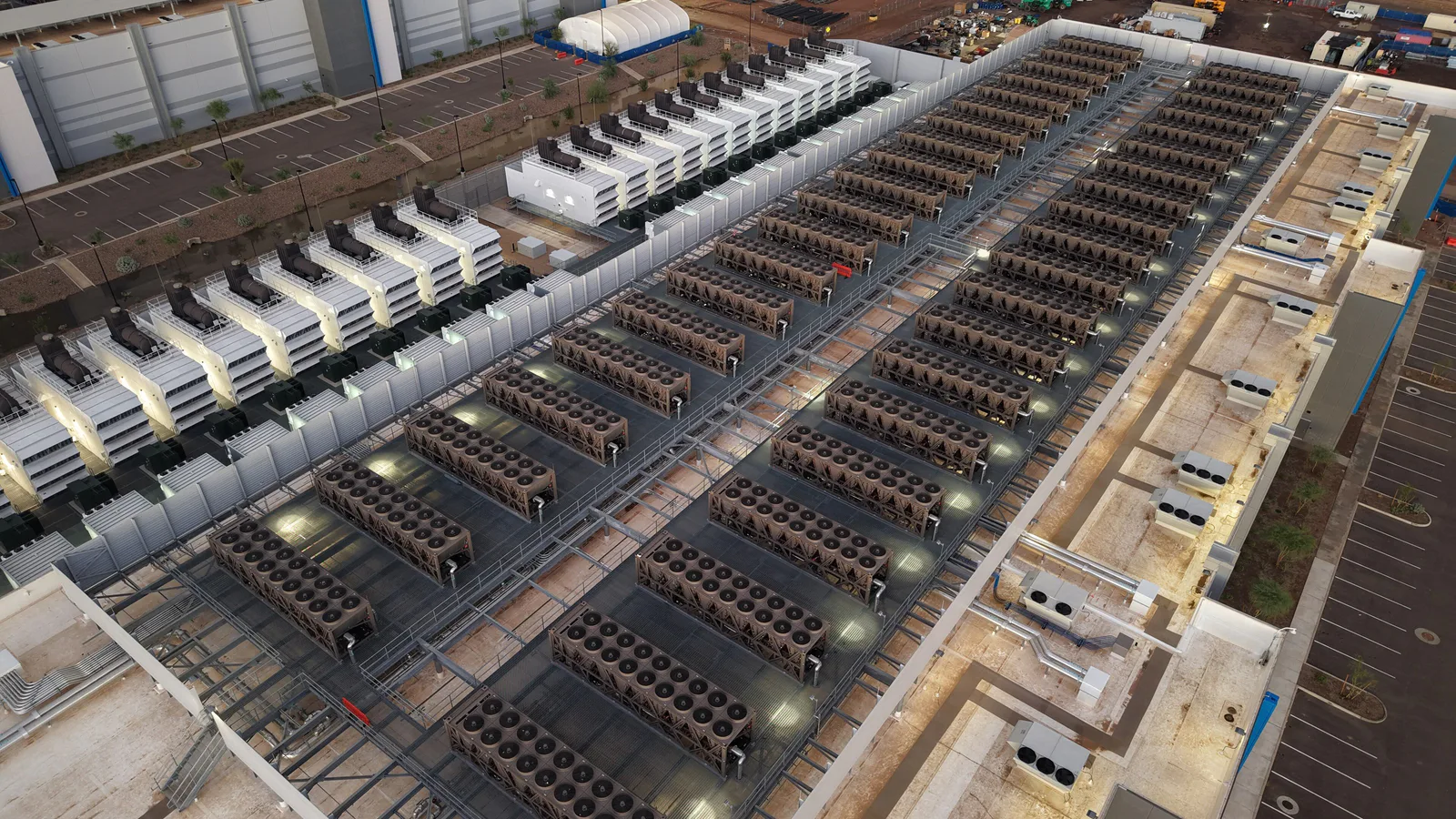
A single AI prompt can use less energy than nine seconds of TV, by Google's estimate, while data-center demand climbs fast. Here is what the IEA, Berkeley Lab, EPRI, Google, and Microsoft estimated or reported, what share, if any, they attribute to AI, and why that share is still an estimate.
Two kinds of claims about artificial intelligence and electricity can sound contradictory. One is that AI could overwhelm power grids. The other is that a single chatbot prompt uses less energy than nine seconds of television, by Google's count. Both can be true; they describe different things. They are easier to reconcile once three numbers are pulled apart: the energy of a single request, the electricity used by data centers today, and forecasts of how much they will need by the end of the decade.
Three numbers that get mixed up
The first number is per-request energy: how many watt-hours it takes to answer one prompt. It is tiny, and the most detailed figure in these sources comes from a company measuring its own service. The second is total data-center demand: how many terawatt-hours (a terawatt-hour is a billion kilowatt-hours) all data centers draw in a year, whether they are serving AI, video, email, or banking. It is large, and it is estimated with models; as Berkeley Lab notes, limited data constrains the analysis. The third is the forecast: a range of scenarios for what that total could become. It is the largest and the least certain of the three.
A per-prompt figure describes the efficiency of one service, a total describes what grids carry now, and a forecast describes what planners are preparing for. Mixing them is how a reader ends up believing both that AI is trivial and that it is a crisis.
The smallest number: one prompt
The most detailed per-request figure among these sources comes from Google. In a technical paper and blog post published on August 21, 2025, the company estimated that the median text prompt in its Gemini Apps used 0.24 watt-hours of electricity, emitted 0.03 grams of carbon dioxide equivalent, and consumed 0.26 milliliters of water. Google compared the energy to watching television for less than nine seconds and the water to about five drops.
Google says its estimate counts the full serving system: the AI chips, the host computers' processors and memory, idle machines kept ready for traffic spikes, and data-center overhead such as cooling. Counting only the active AI chips, Google said, would give 0.10 watt-hours per prompt, a figure the company itself called “an optimistic scenario at best” that “substantially underestimates” the real footprint. The same post reported that, comparing May 2025 with a May 2024 baseline, energy per median prompt fell by a factor of 33 and its carbon footprint by a factor of 44.
Those are company numbers. Google's footnotes say the efficiency comparison has not been verified by an independent third party, and that the estimates do not represent all prompts and are not indicative of future performance. The accompanying paper was posted to arXiv, a preprint server, and its arXiv record lists no journal publication. The figures also cover text only, not image or video generation, and not the energy used to train models in the first place.
An earlier outside estimate for chatbots was far higher. In a 2024 study, the Electric Power Research Institute (EPRI) cited an estimate of 2.9 watt-hours for a ChatGPT query, about 10 times the 0.3 watt-hours it cited for a traditional Google search. Google's paper describes its own result as substantially lower than many public estimates.
The middle number: data centers today
The International Energy Agency's Energy and AI report, published April 10, 2025, estimates that data centers worldwide used about 415 terawatt-hours in 2024, around 1.5% of global electricity consumption. The IEA says that figure has grown by about 12% a year since 2017, and that the United States accounted for the largest share of the 2024 total, at 45%.
For the United States, the estimate comes from Lawrence Berkeley National Laboratory's 2024 United States Data Center Energy Usage Report, a report to Congress released in December 2024. It estimates that US data-center electricity use held roughly flat at about 60 terawatt-hours a year from 2014 through 2016, then began rising as servers accelerated with graphics processing units (GPUs) for AI became a significant part of the server fleet. By 2023, the report estimates, data centers used 176 terawatt-hours, or 4.4% of total US electricity consumption.
The report also gives an AI-specific figure. It estimates that GPU-accelerated AI servers used less than 2 terawatt-hours in 2017 and more than 40 terawatt-hours in 2023, while conventional servers roughly doubled from 2014 to 2023, from about 30 to nearly 60. That AI number covers the servers alone, not the cooling and power equipment that serves them.
Note what the headline totals are not. The 415 and 176 terawatt-hour figures are not AI's electricity alone; they include every kind of computing a data center does. Berkeley Lab's AI-server estimate is AI-specific but covers servers only, and its authors are blunt about their limits: “the lack of data availability significantly limits the analysis in this report,” they write.
The biggest number: the forecasts
Forecasts carry the widest ranges. The IEA's Base Case has global data-center consumption more than doubling to about 945 terawatt-hours by 2030, with electricity use by accelerated servers, which the agency says is mainly driven by AI adoption, growing about 30% a year compared with 9% for conventional servers. In that case, the IEA says, accelerated servers account for almost half of the net increase in global data-center electricity consumption. The agency's scenarios for 2035 span 700 to 1,700 terawatt-hours. The IEA says there is substantial uncertainty about data-center consumption both today and in the future.
Berkeley Lab projects US data centers will use between roughly 325 and 580 terawatt-hours in 2028, or 6.7% to 12.0% of forecast US electricity consumption. The spread depends on how many AI chips are shipped, how intensively they are used, and what cooling systems operators choose.
EPRI's forecasts show how fast these ranges move. Its 2024 study laid out four scenarios that put US data centers at 4.6% to 9.1% of the country's electricity by 2030. Its 2026 update, Powering Intelligence 2026, projects 9% to 17% by 2030, up from 4% to 5% today, and says its estimated 2030 electricity demand is about 60% higher than the estimates it published in 2024. EPRI says the increase largely reflects the accelerated pace of data-center development over the previous 18 months.
What the company reports show
Company environmental reports show the direction, though they cannot be added up into a national total. Google's 2026 Environmental Report says its data centers used about 42.4 million megawatt-hours (42.4 terawatt-hours) of electricity in 2025, up from about 30.6 million in 2024. The company says its total electricity consumption grew 37% in 2025, after 27% growth in 2024, and that it again matched all of its electricity use with renewable energy purchases on a global and annual basis.
Microsoft's 2026 Environmental Sustainability Report, covering its fiscal year that ended in June 2025, shows electricity use of about 37.0 million megawatt-hours, up from 29.8 million the year before and 10.8 million in fiscal 2020, according to the company's data fact sheet. In a July 9, 2026, post, Microsoft said its total emissions rose 25% year over year, driven primarily by the expansion of its data-center infrastructure and by pausing its use of what it calls non-additional, unbundled renewable energy certificates.
These are company-reported figures under each company's own accounting rules. Microsoft's fact sheet says Deloitte & Touche performed a limited-assurance review of the specified Section 1 information, including electricity, for fiscal 2025, and that its earlier reviews do not cover later revisions to prior-year figures. Google's data-center figure and Microsoft's company-wide figure include every workload, not AI alone, and the environmental reports cited here do not break out how much of the growth comes from AI.
What the numbers hide
Side by side, the sources show four blind spots.
First, AI's share is estimated, not measured. Berkeley Lab puts US AI-server electricity above 40 terawatt-hours in 2023, servers only, and the IEA attributes almost half of projected growth to accelerated servers. EPRI put AI at 10% to 20% of data-center electricity in its 2024 study and 15% to 25% in its 2026 update, which cites the IEA and JLL. Google's and Microsoft's environmental reports cited here do not report how much of their electricity goes to AI.
Second, boundaries differ. Google's paper reports 0.10 watt-hours under a narrower approach and 0.24 under its comprehensive one for the same median prompt, a 2.4-fold gap that comes from what is counted and which data centers are sampled. Without a shared definition, two honest companies can report very different numbers for similar work.
Third, averages hide location. A global share of about 1.5% says little about a single region where many data centers cluster on one grid. The IEA notes that the United States and China together account for nearly 80% of projected global growth to 2030.
Fourth, efficiency and volume pull in opposite directions. Google reports a 33-fold drop in energy per median prompt between May 2024 and May 2025, while its own data-center electricity use rose by more than a third from 2024 to 2025. Each request can get cheaper while total demand keeps growing.
Without a shared definition, two honest companies can report very different numbers for similar work.
What better disclosure would look like
The Berkeley Lab report identifies benchmarking initiatives and collaboration with electric utilities as areas for future research, and says greater transparency in data-center energy use would further that work. Based on what the sources above can and cannot answer, useful disclosure would use a common boundary for per-request figures, and would report image, video, and long-running agent tasks, not only the median text prompt. Operators would break out AI workloads within their own reported electricity. It would report by grid region rather than only as a global annual sum, since regional load is what utilities must plan for. And it would be checked by someone other than the company publishing it.
Until then, the honest answer to "how much energy does AI use?" is a set of answers with labels attached. A single text prompt, by one company's measurement, uses a fraction of a watt-hour. Data centers of every kind used around 1.5% of the world's electricity in 2024, by the IEA's estimate. By 2030 that total could more than double in the IEA's Base Case, though EPRI's sharp upward revision shows how quickly such forecasts move. Each number is useful; none is the whole story.
Sources
- Energy and AIInternational Energy Agency, April 10, 2025 · Primary source
- Energy and AI: Executive summaryInternational Energy Agency, April 10, 2025 · Primary source
- Energy and AI: Energy demand from AIInternational Energy Agency, April 10, 2025 · Primary source
- 2024 United States Data Center Energy Usage Report (LBNL-2001637)Lawrence Berkeley National Laboratory · Primary source
- Measuring the environmental impact of AI inferenceGoogle Cloud Blog, August 21, 2025 · Primary source
- Measuring the environmental impact of delivering AI at Google Scale (arXiv:2508.15734)arXiv (Elsworth et al., Google), August 21, 2025 · Primary source
- Powering Intelligence: Analyzing Artificial Intelligence and Data Center Energy ConsumptionElectric Power Research Institute, May 28, 2024 · Primary source
- EPRI Study: Data Centers Could Consume up to 9% of U.S. Electricity Generation by 2030Electric Power Research Institute (via PR Newswire), May 29, 2024 · Primary source
- Powering Intelligence 2026: Updated Scenarios of U.S. Data Center Electricity Use and Power StrategiesElectric Power Research Institute, February 25, 2026 · Primary source
- Google 2026 Environmental ReportGoogle · Primary source
- 2026 Environmental Sustainability Report Data Fact SheetMicrosoft · Dataset
- Responsibly building the AI futureMicrosoft On the Issues, July 9, 2026 · Primary source
Corrections and updates
No corrections have been made to this article. How we handle corrections
Sources last checked .