

A crash in 2022 proved a spacecraft can change an asteroid's orbit. It did not explain why the push was so much bigger than models predicted. ESA's Hera spacecraft, which the agency says reached the Didymos asteroid pair in November, is there to find out, starting with how much the target weighs, a number nobody has yet measured.
Four years ago a spacecraft the size of a vending machine flew into a small asteroid at 6.1 kilometers per second, and the asteroid's orbit changed. That was the point. NASA's Double Asteroid Redirection Test, or DART, struck the moonlet Dimorphos on September 26, 2022. R. Terik Daly and colleagues later described the mission in Nature as a full-scale test of kinetic impact technology, and Andrew Cheng and colleagues called it the first hypervelocity impact experiment on an asteroid at the size and velocity scales relevant to planetary defense. Now a second spacecraft has arrived to inspect the result. The European Space Agency said on November 11 that its Hera spacecraft, launched on October 7, 2024, had arrived at the Didymos asteroid system and begun its early characterization phase. ESA says it plans to release detailed images of both asteroids on November 25.
Why send a second mission to a target that has already been hit? Because, as ESA puts it, the deflection was much greater than impact simulations predicted, and the properties that explain it are still unknown. In Magupon's reading, until that is settled, hitting an asteroid to move it remains a successful demonstration rather than a fully understood tool.
What DART actually did
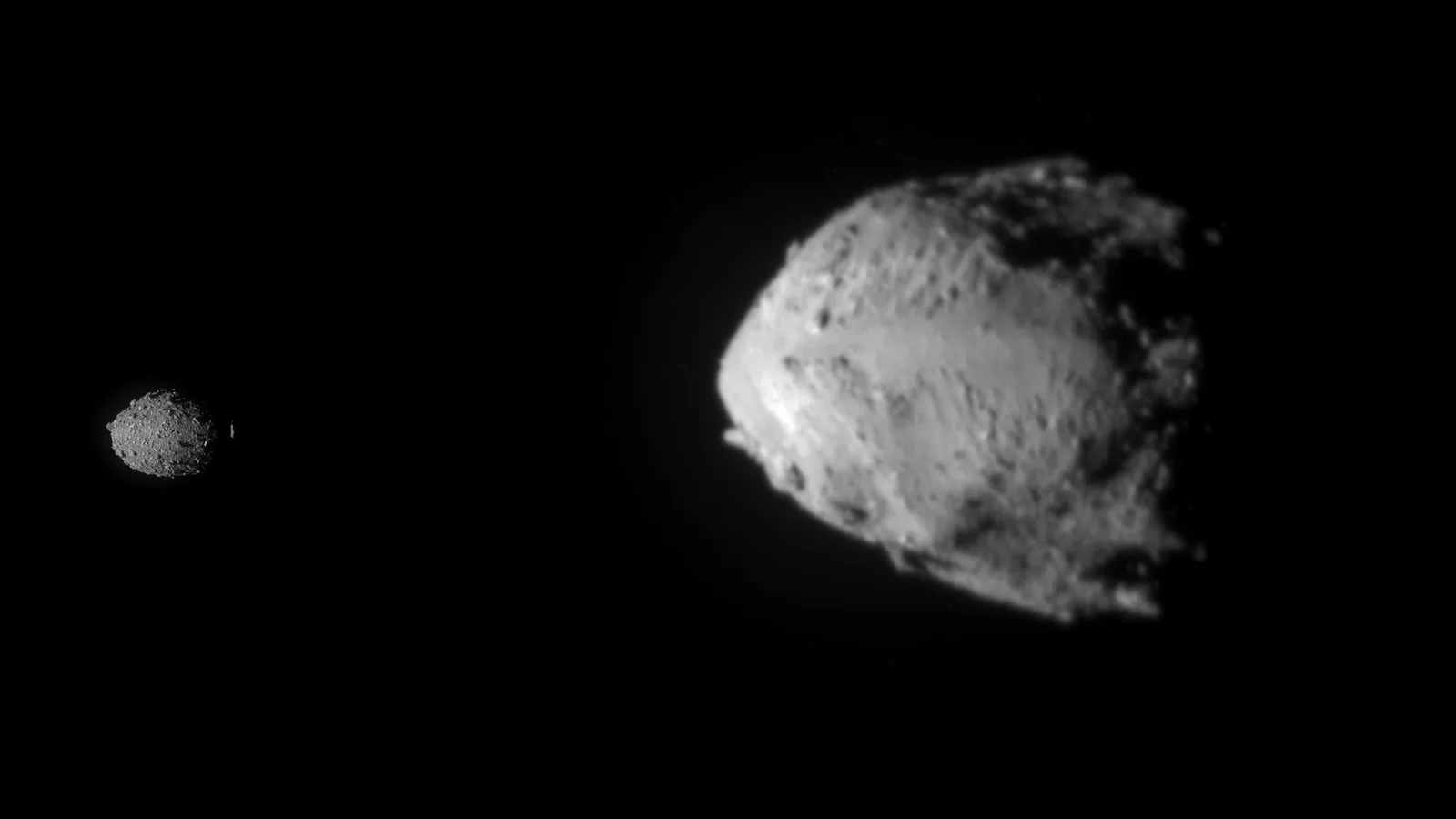
Dimorphos is small. ESA gives its diameter as 151 meters, about the size of the Great Pyramid of Giza. It circles a larger asteroid, the 780-meter Didymos, at an average distance of 1.15 kilometers. Daly and colleagues note that the binary system was chosen so that ground-based telescopes could measure the deflection. ESA explains how: the pair's orbit can be followed from Earth through lightcurves, slight changes in the combined light of the two bodies.
Before the impact, Dimorphos took 11 hours and 55 minutes to circle Didymos, according to ESA's Hera media kit. In their Nature paper, Cristina Thomas and colleagues wrote that a change of about 7 minutes was expected if DART's momentum had simply been absorbed in a perfectly inelastic collision, though earlier studies had indicated a considerable boost was possible. What they measured, using lightcurve and radar observations, was a period change of 33.0 minutes, plus or minus 1.0 minute at a 3-sigma confidence level. Two independent methods gave the same value.
The extra push came from the debris. Thomas and colleagues wrote that the result suggests ejecta contributed a substantial amount of momentum beyond what the spacecraft carried, and Cheng's team attributed the enhanced momentum transfer to recoil from ejecta streams. ESA says the plume stretched more than 10,000 kilometers into space and persisted for months, and that 37 boulders were seen flying away.
Cheng and colleagues turned the period change into a quantity they describe as a key objective of the mission: the momentum enhancement factor, written as beta. It measures how much momentum the asteroid received relative to the momentum DART carried; in their momentum balance, a value of 1 means no extra push from ejecta. They found that DART slowed Dimorphos's along-track orbital velocity by 2.70 millimeters per second, plus or minus 0.10. For a plausible range of densities, the expected value of beta came out between 2.2 and 4.9. If both asteroids share a density of 2,400 kilograms per cubic meter, the expected value is 3.61, with a 1-sigma uncertainty of +0.19 and -0.25.
That spread is the whole story in miniature. The answer depends on the mass of Dimorphos, and the mass of Dimorphos has never been measured.
The answer depends on the mass of Dimorphos, and the mass of Dimorphos has never been measured.
Why a second look matters
In Magupon's analysis, a deflection method becomes dependable only when its effect on a given asteroid can be predicted in advance, and a beta that might be 2 or might be 5 is a wide margin.
ESA lists the gaps in its own words. Models of the impact still lack the mass of Dimorphos, its internal structure, whether DART left a crater or caused a global reshaping, and the overall efficiency of the momentum transfer. ESA adds that measurements of the precise characteristics of the impact-altered orbit made from Earth are stuck with a 10% residual uncertainty. ESA says Hera will observe Dimorphos up close and that its data will validate scientific models of DART's impact.
Hera is the European half of an international collaboration called the Asteroid Impact and Deflection Assessment. NASA's DART was the first part; Hera, built by a European industrial consortium led by OHB, is the follow-up. It weighs about 1,081 kilograms fully fueled and carries, together with its two small companion satellites, 11 instruments plus a radio-science experiment, according to ESA. The agency puts the mission's overall cost at €350 million, including spacecraft and payload development, launcher procurement, and operations, with around 100 companies and institutes across 18 ESA member states involved.
The Didymos pair poses no threat to Earth. ESA notes that the system came no closer than 11 million kilometers during its 2022 approach, which ESA says makes the system an ideal candidate for orbital deflection experiments.
The long way to Didymos
Hera's route was indirect. After launching on a SpaceX Falcon 9 from Cape Canaveral, it swung past Mars on March 12, 2025, using the planet's gravity to bend its path. A deep-space maneuver early in 2026 then set it on course for the asteroids. ESA reported in March 2026 that this burn used 123 kilograms of hydrazine propellant and changed the spacecraft's speed by 367 meters per second, the mission's largest maneuver by fuel consumed.
In October 2025, ESA said good spacecraft performance would let Hera arrive in November 2026, a month earlier than originally planned, by braking later and harder on approach. In October 2026, a pair of thruster firings a week apart slowed Hera to 20 meters per second relative to the two asteroids, according to ESA, and it began closing in gradually.
The first view that split the pair came in mid-October; ESA's release dates it to October 18. Until then the system had appeared as a single dot. "With this image the smaller Dimorphos asteroid becomes visible for the first time," said Michael Kueppers, quoted in ESA's October 27 release. In that image Dimorphos covered about one pixel.
On November 11, ESA announced that Hera had arrived. The agency said the spacecraft was holding roughly 25 to 30 kilometers from the pair, flying nearly straight legs and 90-degree course changes it calls rectangular orbits, because in such low gravity a traditional circular orbit is impractical. ESA says Didymos's gravity is about 40,000 times weaker than Earth's, and Dimorphos's about 200,000 times weaker.
By November 12, ESA had released a closer look at Didymos, showing large boulders, smoother regions, and what the agency called a surprisingly sharp ridge around its equator. Didymos spins once every 2.2 hours, fast enough, ESA says, that it is close to coming apart. "Didymos is spinning very rapidly for its size, rotating every 2.2 hours, so this spin might actually be encouraging this migration of material towards the equator, helping form this ridge," said Patrick Michel, Hera's principal investigator and a director of research at France's CNRS, in an ESA release on November 17. ESA adds that it might even be possible that some material shed from Didymos accounts for the existence of Dimorphos itself.
What Hera will measure
The first job, part of the early characterization phase now under way, is weighing Dimorphos. You cannot put an asteroid on a scale, so Hera will watch it pull on its neighbor. ESA says the team will track landmarks such as boulders on Didymos to see how the larger body wobbles around the pair's shared center of mass. That wobble depends on how heavy the moonlet is. Tiny Doppler shifts in Hera's radio signal as it flies past will add to the picture of Dimorphos's gravity.
Three instruments already at work show how much more than a picture each observation contains. The Asteroid Framing Camera takes monochrome images used for both navigation and science. HyperScout H splits reflected sunlight into 25 bands, from visible red into the near-infrared, so the surface can be compared with laboratory measurements of meteorites and minerals. A Thermal Infrared Imager supplied by the Japan Aerospace Exploration Agency maps how surface temperatures change, which indicates whether the ground is solid rock, porous or broken rock, or loose material down to dust. In one set of images released on November 17, Dimorphos sat almost entirely in shadow in these images, except in the thermal view, where the whole moonlet showed up.
Closer passes and two small helpers
ESA's published plan then steps closer in stages. The early characterization phase of about 6 weeks flies arcs 20 to 30 kilometers from the asteroids to measure their shape, mass, temperature, and motion. A 4-week detailed phase moves in to 8 to 10 kilometers for meter-scale mapping; ESA said on November 11 that it was scheduled to begin in December, starting from around 20 kilometers away. After that come a 4-week phase to release the companion satellites and a 6-week close-observation phase with 12 close flybys, covering much of Dimorphos's surface, including the DART impact site. ESA says the moonlet will be mapped to a resolution of a few meters, with selected regions down to 10 centimeters.
Juventas addresses the structure question. ESA asks whether Dimorphos is a rubble pile held together by weak gravity or has a solid core surrounded by boulders and dust, and says the CubeSat's radar will peer deep beneath the surface in what ESA describes as the first radar probe of an asteroid's interior. ESA expects the full investigation of the Didymos system to take about 6 months, ending in mid-2027, after which Hera is planned to become a testbed for onboard software and autonomy in deep space.
How planetary defense is organized
In Magupon's reading, deflection would be the last step in a longer chain. ESA's media kit sets out the four stages that come before it. First, detection: survey telescopes and observers find near-Earth objects. Second, the International Astronomical Union's Minor Planet Center collects observations from around the world and acts as the clearing house for orbit data. Third, risk analysis: ESA's Near-Earth Object Coordination Centre and NASA's Center for Near-Earth Object Studies compute orbits and estimate the chance and effects of an impact. Fourth, warning: if an object is judged dangerous, national civil authorities and the United Nations are alerted, with support from the space agencies.
In the United States, NASA established its Planetary Defense Coordination Office in 2016 to manage what the agency calls its ongoing mission of finding, tracking, and better understanding asteroids and comets.
Detection has gaps. ESA says most kilometer-class near-Earth asteroids have been found, but most objects in Dimorphos's size class, of which it says there may be up to 30,000 near Earth, have not. ESA points out that the 2013 Chelyabinsk airburst, whose shock wave struck six Russian cities, was caused by an asteroid only about 20 meters across.
NASA's answer is NEO Surveyor, an infrared space telescope. According to NASA's Jet Propulsion Laboratory, it is planned to launch no earlier than September 2027 and, during a 5-year baseline survey, to find at least two-thirds of the near-Earth objects larger than 140 meters. That would advance a goal Congress set for NASA: finding more than 90 percent of near-Earth objects of that size.
The technique, not the target
The value of DART and Hera, in Magupon's reading, is that they can turn a one-time crash into a calibrated method. ESA says Hera's data will validate scientific models of DART's impact, the models that underestimated the push.
ESA and JAXA also plan Ramses, a mission built on Hera's design, to launch in spring 2028 and fly alongside the roughly 340-meter asteroid Apophis as it passes within 32,000 kilometers of Earth on April 13, 2029. ESA describes it as a chance to observe any physical changes in the asteroid caused by Earth's gravity.
For now, ESA says the first detailed close-ups of Dimorphos, which it calls the first body in the solar system to have had its orbit measurably changed by human action, are due on November 25. They will not settle the beta question on their own. ESA's plan puts the mass measurement in the phase now under way and the radar soundings after the CubeSats are released in early 2027, with the investigation running into mid-2027.
Sources
- Orbital period change of Dimorphos due to the DART kinetic impact (Nature 616, 448–451)Nature (Thomas et al.), March 1, 2023 · Primary source
- Successful kinetic impact into an asteroid for planetary defence (Nature 616, 443–447)Nature (Daly et al.), March 1, 2023 · Primary source
- Momentum transfer from the DART mission kinetic impact on asteroid Dimorphos (Nature 616, 457–460)Nature (Cheng et al.), March 1, 2023 · Primary source
- Hera: ESA's Planetary Defence Mission — Media Kit (November 2026)European Space Agency, November 17, 2026 · Primary source
- First light: Hera resolves two asteroids instead of oneEuropean Space Agency, October 27, 2026 · Primary source
- Hera spies a half-hidden asteroid moonletEuropean Space Agency, November 12, 2026 · Primary source
- Hera surveying asteroids with superhuman visionEuropean Space Agency, November 17, 2026 · Primary source
- ESA's Hera targets early arrival at Didymos asteroidsEuropean Space Agency, October 7, 2025 · Primary source
- Hera on course for asteroid rendezvousEuropean Space Agency, March 17, 2026 · Primary source
- Hera's CubeSatsEuropean Space Agency, June 4, 2018 · Primary source
- DART (Double Asteroid Redirection Test) mission pageNASA · Primary source
- Planetary DefenseNASA · Primary source
- NEO Surveyor (Near-Earth Object Surveyor) mission pageNASA Jet Propulsion Laboratory · Primary source
- Hera spacecraft in 'rectangular orbit' around target asteroidsEuropean Space Agency, November 11, 2026 · Primary source
- File:High-Resolution Didymos and Dimorphos - North Up.png (image description page)Wikimedia Commons (NASA/Johns Hopkins APL) · Secondary source

Corrections and updates
No corrections have been made to this article. How we handle corrections
Sources last checked .